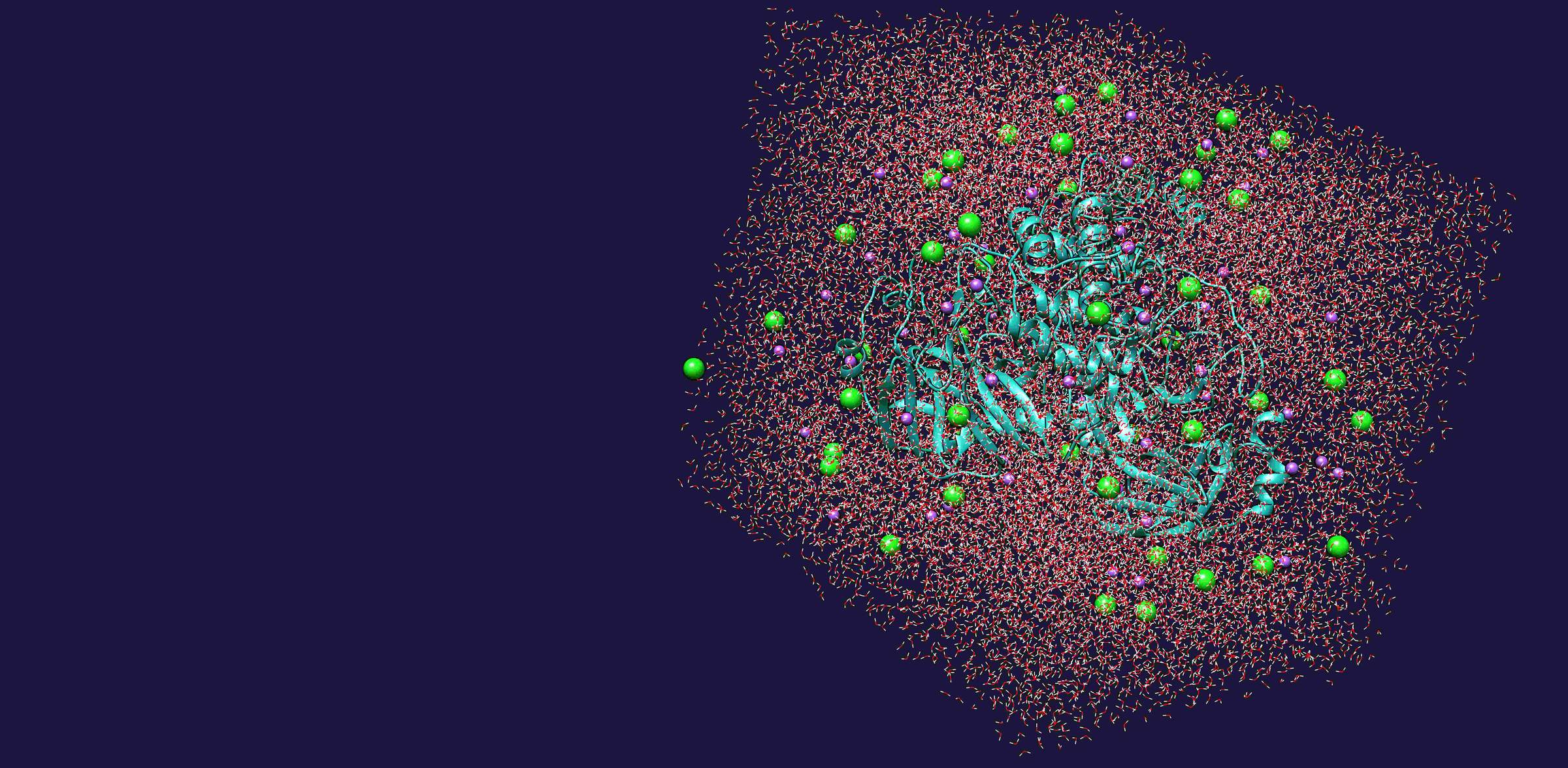
From first principles to function — rigorous simulations that answer the questions your experiments alone cannot.
Your experiment tells you what happens. Our simulations tell you why. We run end-to-end MD simulations for academic groups, graduate students, and industry teams — from a single-protein thesis chapter to multi-compound drug discovery pipelines. Every project is built on validated protocols, reproducible workflows, and results you can publish.
We map your protein's intrinsic flexibility, domain motions, and conformational landscape. Know the baseline before you interpret binding data or mutation effects.
All-atom simulations of your drug–target, substrate–enzyme, or inhibitor–protein complex. We assess pose stability, residence time, key contacts, and the energetics driving recognition.
Simulations of homodimeric, heterodimeric, and multimeric assemblies. We characterize interface stability, cross-chain contact networks, and allosteric communication pathways between subunits.
Wild-type vs. mutant, side by side. We quantify the structural and dynamic consequences of point mutations, insertions, or deletions — giving you the mechanistic evidence for rational design and variant interpretation.
Rigid and flexible docking of small molecules, peptides, and fragments against protein targets. Pose prediction, scoring, and consensus ranking across multiple docking programs.
We dock against MD-derived conformational ensembles, not a single crystal structure. This captures induced-fit effects and cryptic binding sites that static structures miss entirely.
Generative model-based docking that predicts binding poses without conventional search-and-score. Ideal for blind docking where the binding site is unknown. We use it alongside physics-based methods for better pose diversity and stronger consensus.
Short MD runs on top-ranked docking poses to filter false positives, confirm pose stability, and refine binding modes — before committing to longer, costlier simulations.
All-atom simulations of cellulose microfibrils, lignin oligomers, and cellulose–lignin composites. We study structural rigidity, solvent accessibility, enzymatic degradation surfaces, and pretreatment effects.
Simulations of polymer chains, blends, and assemblies (e.g. natural rubber), characterizing chain flexibility, radius of gyration, glass transition behavior, and intermolecular packing.
Alchemical free energy calculations for quantitative prediction of relative binding affinities, solvation free energies, and mutation-induced stability changes. The gold standard when you need numbers, not just trends.
Metadynamics, replica exchange (REST2/REMD), and accelerated MD for systems trapped in local minima. Essential for studying slow conformational transitions, folding events, and rare binding/unbinding pathways.
Martini and related CG models for studying large-scale membrane dynamics, protein aggregation, polymer self-assembly, and systems that exceed all-atom timescale limitations.
Quantum mechanical treatment of reaction centers within a classical MD environment. For enzymatic mechanisms, electron transfer, and systems where bond breaking is at the heart of your question.
AlphaFold and ColabFold for high-confidence structure prediction. ESM-2 for sequence-based structural and functional annotation. AI-predicted structures serve as starting points for MD validation and refinement.
RFdiffusion for generative protein backbone design. REINVENT4 for de novo small molecule generation and lead optimization guided by multi-parameter objectives.
DiffDock for deep learning-based molecular docking. Integration of ML-interatomic potentials (ANI-2x, DeePMD-kit) for accelerated energy evaluations and hybrid simulation workflows.
Every project gets a tailored analysis package — the specific metrics that answer your question, not a generic folder of plots. Every deliverable goes directly into your manuscript, thesis, or technical report.
System setup details (force field, box dimensions, ion concentration, equilibration protocol), production run parameters, and quality control metrics.
Publication-quality figures with clear annotations, statistical analysis, and interpretation tied to your specific scientific question. For academic clients, written to be directly insertable into a methods/results section. For industry clients, formatted as a structured technical report.
Topology files, representative trajectory frames (or full trajectories upon request), and a detailed methods summary for reproducibility.
A ready-to-use methods section drafted for your manuscript, thesis, or internal documentation, with appropriate citations for force fields, software, and analysis protocols.
Every project is executed on industry-standard and state-of-the-art platforms, ensuring reproducibility and methodological rigor.
A structured, transparent process from your first message to the final figure: every decision documented and every output explained.
You share your question — a paper you are writing, a hypothesis to test, a reviewer's request. We define the strategy together: what system, what method, what timescale, and exactly which analyses will answer it.
We build, parameterize, and validate your system from scratch — structure curation, protonation states, force field selection, solvation, ionization, energy minimization. Every setup decision is documented and justified before a single simulation step is run.
Simulations run on GPU-accelerated HPC infrastructure. We run a minimum of three independent replicates for statistical robustness. Convergence and quality are monitored throughout — not just checked at the end.
We do not hand you a folder of plots. Every figure is interpreted in the context of your biology. If the data points to a follow-up simulation or a better approach — we tell you.
You receive the full package: report, figures, raw data, and publication-ready methods text. We stay available through peer review — revision requests, reviewer responses, and follow-up analyses included.
Four tiers to match your scope — a thesis chapter, a comparative study, an integrated design pipeline, or ongoing support. Every package includes raw data, reproducible scripts, and post-delivery support through publication. Pricing on consultation.
Best for: A lab or graduate student that needs one protein or complex simulated to support a paper or thesis chapter.
Best for: Wild-type vs. mutant, apo vs. bound, or ligand comparison studies.
Best for: Projects requiring advanced sampling, free energy calculations, or AI-driven design components.
Best for: Labs or companies that need a computational collaborator on an ongoing basis.
Have a structure to simulate? A binding question to answer? A reviewer asking for MD data? Send us your question — we will design the simulation strategy and deliver results you can publish.
Discuss Your ProjectTypical response time: 48 hours. Student projects, academic labs, and industry R&D all welcome.